Local shop's ornaments represent meaning of
Christmas

Barbara Rufty and Melonie Beaver pose in the room where the
beaded Christmas symbol kits
are assembled at Rufty's Chrismon Shop. Photo by Jon C. Lakey,
Salisbury Post
By Michelle Lyerly
For the Salisbury Post
Just like the biblical story of the boy with the fish and the loaves, Frances
Kipps Spencer's ministry began with just a few scraps.
As was customary in Danville, Va. in the 1940s, domestic servants would stop
by their employer's house to offer a "Merry Christmas" in exchange
for a gift.
The Spencers' yard and furnace man and pastor of a small local church, the
Rev. George Pass, stopped by the Spencer home in accordance with custom and
noticed their discarded Christmas wrappings.
He asked the Spencers if he could use the scraps to make ornaments for his
church tree.
Frances Spencer agreed. And with that, she began thinking.
A member of Ascension Lutheran and daughter of a minister, Spencer noticed
how area churches used regular Christmas ornaments having no connection with
the real reason for the season-- the birth of Jesus.
And with that came the advent of Chrismon ornaments -- meaning the "monogram
of Christ" -- depicting symbols representing the birth and ministry of
Jesus.
Spencer searched far and wide for beads, but she was running out of options
for her unique designs.
In 1964, Chrismon makers from Statesville recommended Rufty's Garden Shop in
Salisbury. The rest, as they say, is history.
"At that time, we sold beads," said Barbara Rufty.
"That's when love beads were popular in the 1960s," added her daughter,
Melonie Rufty Beaver.
Harold and Barbara Rufty developed an ongoing partnership with Spencer, and
over time took over the Chrismon tradition, constructing their own Christian
symbols, not to be confused with Spencer's copyrighted Chrismon designs.
"She'd make a design and bring it to us; if we found any odd ones (beads),
we'd bring her some," said Barbara Rufty.
Still, the Ruftys had to search far and wide for some of the rarest beads,
traveling as far as New York and making calls to Japan.
Spencer died in 1990, but Rufty's Chrismon Shop off Furniture Drive keeps copies
of her instruction manuals on hand, which include Bible studies explaining the
significance of the symbols.
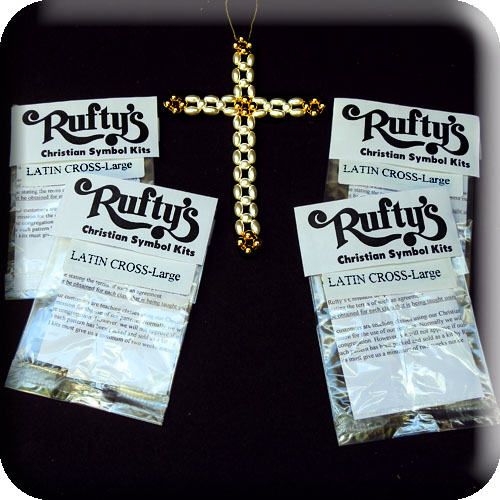
Rufty's Chrismon Shop also publishes its own set of original Christian symbol
pattern instruction manuals, including its recent "Glory Angels" (2007)
and "Flowers of Faith," with the advanced edition arriving in 2008.
Rufty's also offers instructional classes to interested churches and groups,
as well as selling supplies across the nation.
"We talk to people all over the United States," including Alaska,
said Beaver.
Some churches take their Chrismon designs overseas on mission trips to places
like Africa and Russia.
St. John's Lutheran is one of many area churches carrying on the Chrismon tradition.
Last week, Our State magazine came by to take pictures of the St. John's Chrismon
display and stopped by Rufty's Chrismon Shop for its winter edition.
Located in the narthex of St. John's Lutheran Church are the three crowns --
the Crown of Light, the Ten Commandments and the Crown of Cross -- along with
the four Glory Angels and the Children's Tree.
The Crown of Light is an original design containing six points, each with a
candle. It represents Christ, the light of the world.
The Ten Commandments design is a ten-pointed crown representing the kingship
of Jesus.
The Crown of the Cross has a cross in each of its eight points, symbolizing
redemption through sacrifice and the eight days of resurrection.
Each of the four "glory angels" holds an instrument -- a trumpet,
flute, lute and lyre.
The ornaments for the Children's Tree are made by the children in weekday church
school.
Each year, a Chrismon ornament is made for each child, and by the time they
are eighteen, they have enough ornaments to display on a tree in their college
dorm room.
The tree in the main sanctuary bears many original Chrismon designs as well
as recent Christian symbols, such as the "fisherman's net" made out
of wire mesh, "I am the Vine" and the "Pelican," a symbol
of personal sacrifice, a symbol of Christ.
When pelicans cannot find food for their young, they pluck themselves on the
breast and the baby drinks the blood.
"That's the only Chrismon where other colors are used," explained
retired teacher Eleanor Sifford of St. John's Lutheran.
The pelican, like many of the designs, is made from a plastic foam base. Sifford
said many original Chrismons were plastic foam.
Although she was away at college at the time, Sifford, a niece of the Ruftys,
has seen the Chrismon ministry grow from its earliest years into what it is
today.
She feels a sense of pride in the ministry of her family and church.
"Everything on the tree represents Christ and his ministry," she
said. "He is the reason for the season."
Sifford offers Chrismon instruction to churches for free, with the only cost
being the materials and instruction manuals. Instruction is year-round.
Rev. Carl Hanes of Christiana Lutheran expresses his gratitude to the work
of the Chrismon ministry. Some of his church's Chrismon designs date back 20
years or more.
"Well, I think it's just a wonderful reminder of what this season's all
about," Hanes said. "If it were not for Christ, we wouldn't have the
season; it's a beautiful reminder and enhancer to our worship."
Contact Michelle G. Lyerly at 704-932-3336 or mlyerly@kannapoliscitizen.com.

Special decorations: A 15-foot-tall Christmas tree is
decorated with Chrismons from Rufty's Chrismon Shop and other Christian
Symbols in the sanctuary of St. John's Lutheran Church. Photo by Jon C.
Lakey, Salisbury Post |

Crowns are displayed in a case at St. John's Lutheran
Church.Photo by Jon C. Lakey, Salisbury Post |